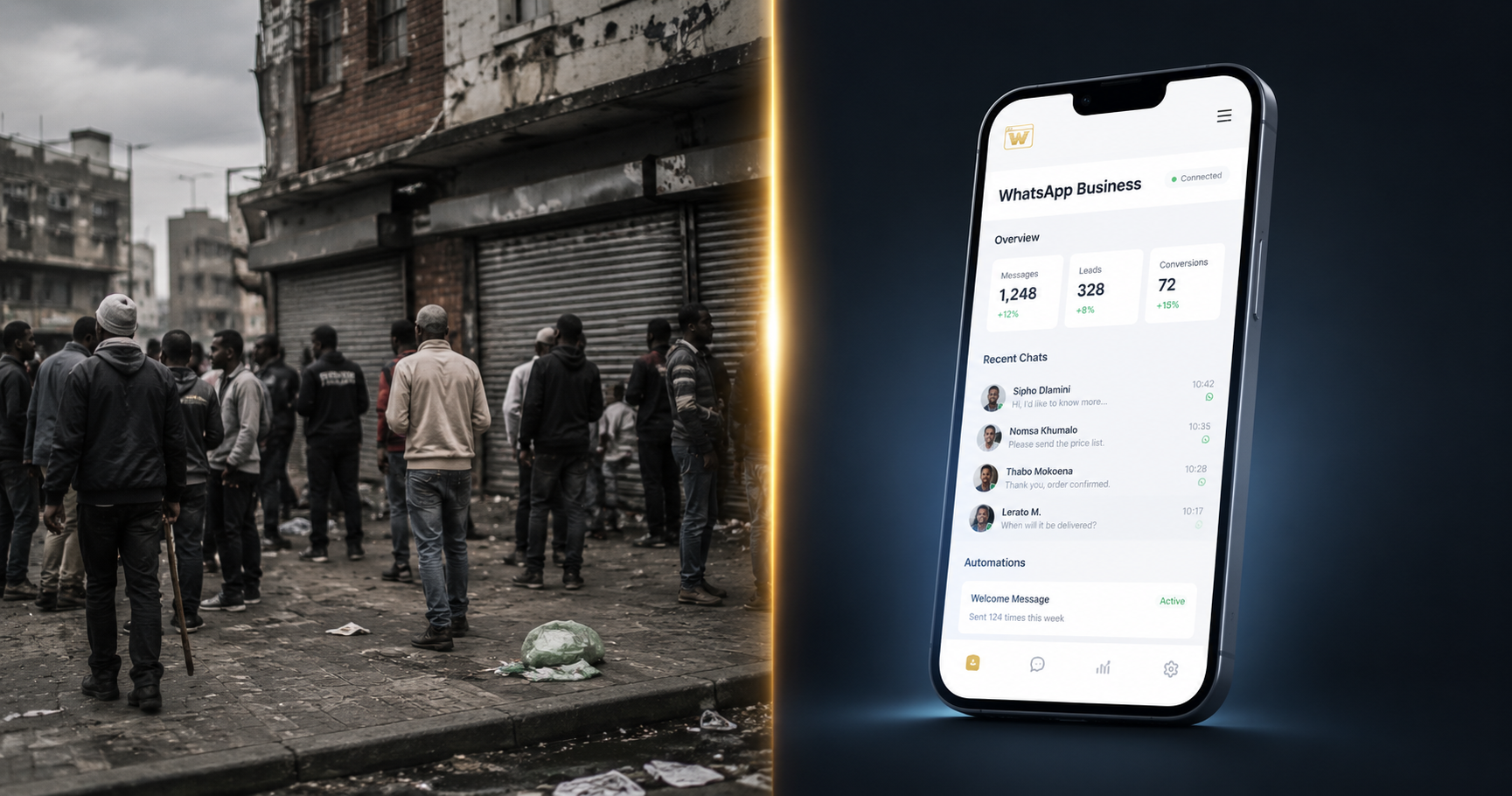
Durban. April 17, 2026.
A Cameroonian man who had built a shop in South Africa over nearly two decades heard the crowd before he saw it. He locked his door. He turned off the lights. He waited.
They broke the door down anyway.
The group, believed to be affiliated with the March and March movement, stormed his shop during the wave of anti-immigrant protests sweeping Durban that month. Nearly twenty years of building something, gone in the time it takes to break a lock.
But he still had his phone. And on that phone were his customers.
The Part Nobody Is Writing About
Right now, more than 3,000 Malawians including hundreds of children are sheltering in an open field in Durban after fleeing escalating threats. Nigeria has begun repatriation flights. Ghana, Mozambique, and Malawi have followed. Governments across Africa are telling their people: come home.
Many are going.
But going home does not have to mean going back to zero.
A physical shop can be looted. A website cannot. A WhatsApp customer list cannot be set on fire. An Instagram following cannot be evicted. The digital business you build today travels with you whether you stay in Johannesburg, return to Lagos, or rebuild somewhere else entirely.
This is not a political piece. It is not about who is right or wrong in a crisis that is painful and has no clean answers. It is about one thing only.
Your business does not have to run with you.
Step One: Claim Your Name Online Today
This costs nothing. Create a WhatsApp Business account, an Instagram page, and a Facebook business page. Use the same name across all three. Do it before anything else.
Your customers are already searching for you. When a shop goes dark, loyal customers do not forget the owner. They look. If your name appears online, they find you. If it does not, they find someone else.
Your digital name is your new address. No march can shut it down.
Step Two: Turn WhatsApp Business Into Your Shop Floor
Set up your business profile with your name, what you sell, your service area, and your hours. Be specific. "Nigerian food, delivery across Johannesburg and Soweto" works better than "food business."
Add a catalogue. Photograph your products or your work. Set up quick replies for common questions. Post a status update every single day showing what you have available.
A customer who cannot safely walk to your neighborhood can still order from you across the city if you deliver. Physical distance stops foot traffic. It does not have to stop sales.
Step Three: Build Your Broadcast List
A WhatsApp Broadcast List lets you send a message to up to 256 people at once. Each person receives it as a private message, not a group chat. No noise. Just your update, direct to people who already trust you.
When your physical location is compromised, this list becomes your entire shop floor.
Every morning, one message: "Good morning. I am still taking orders. Delivery available to [areas]. Contact me here."
Simple. Human. It works because these are not strangers. You are not convincing them. You are just telling them where you are now.
Step Four: Get Paid Without a Physical Counter
SnapScan and Zapper are QR code payment apps widely used across South Africa. Any customer with a smartphone can pay you. You share your QR code as an image on WhatsApp.
If you have a South African bank account, PayShap and Capitec Pay allow real-time transfers between individuals and small businesses, no card machine needed.
If your income needs to cross borders, Mukuru and WorldRemit move money quickly and cheaply across Africa.
Remove every barrier between a customer wanting to pay you and the money reaching you.
Step Five: Build Something That Cannot Be Burned Down
The businesses that survive xenophobia are not the ones that hide until it ends. They are the ones that use the disruption to build something the next wave cannot touch.
Post on TikTok. If you sell food, cook on camera. If you run a salon, show a transformation. If you sell clothing, show yourself picking items. You do not need a ring light or a script. You need to be real and consistent.
Register your business on Google Business Profile. It is free. When someone searches "Nigerian food near me" or "Cameroonian braider Johannesburg," you can appear.
Build a simple website. Platforms like Carrd and Google Sites let you create one for free. It does not need to be beautiful. It needs to say who you are, what you offer, how to reach you, and how to pay you. That is a permanent address that follows you everywhere.
The Longer Truth
Since 2008, South Africa has seen xenophobic waves in 2015, 2019, 2021, and now 2026. After every wave, foreign nationals who stayed rebuilt. Many who left came back. Because South Africa, for all its complexity, remains one of the most economically active countries on the continent.
But every rebuild has taken too long, because every rebuild started from scratch.
The foreign business owner who builds an online presence now, even with a cracked screen and borrowed data, does not start the next cycle from zero. They start it with their customer list intact, their brand visible, and their payment system already working.
Your body may be forced to leave a city, a neighborhood, or a country.
Your business does not have to go anywhere.
If you are a foreign national in South Africa currently facing threats or violence, reach out to the Consortium for Refugees and Migrants in South Africa (CoRMSA) or the Kopanang Africa Against Xenophobia coalition. Both are actively monitoring the situation and providing support.
Want help taking your business online? That is exactly what we do at Webmify.